Not as a One-Off Product
New tools and solutions emerge every day, promising breakthroughs, and yet not all innovations are created equal. With XR in surgical environments, this is especially true. As healthcare teams weigh their options for XR support in complex procedures like spine and cranial surgery, one thing is becoming clear: lasting value doesn’t come from single-purpose tools. It comes from platforms designed for real clinical impact over the long haul.
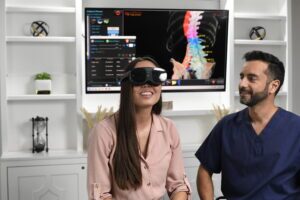
At Surgical Theater, we believe in building technology that’s durable, deeply integrated into clinical workflows, and purpose-driven for the surgeons and teams who rely on it day in and day out. Our eXperiential Reality® (XR) platform is not a point product with a single feature; it is a comprehensive suite of tools that support clinical decisions across the entire continuum of care. From patient consultation and preoperative planning to intraoperative execution, our platform is grounded in how surgeons actually work.
Clinical Utility You Can Count On
Clinical utility is not theoretical. Surgical Theater’s XR platform has supported more than 50,000 XR utilizations across the continuum of care, spanning patient consultation, preoperative planning, and intraoperative execution.
Across clinical studies and real-world use, XR-enabled care has demonstrated measurable impact: 100% of patients reported improved satisfaction and understanding, 90.6% enrolled for surgery after XR visualization, and 24% of surgical plans were modified after incorporating patient-specific 3D models. XR consultations also increased patient retention by 50% while reducing outmigration by 89%
In the operating room, XR-assisted planning has been shown to improve surgical efficiency, including a 29% reduction in time per clip during aneurysm procedures, along with fewer clip attempts and decreased total operative time, without increasing case complexity.
These outcomes move XR beyond visualization and into clinical impact, supporting clearer decisions, greater efficiency, and more confident care.
The Difference Between a Platform and a One-Off Tool
One-off tools solve narrow problems, but their utility often ends where the novelty fades. Too often, these solutions require surgeons to adjust their workflow to accommodate the technology, rather than the other way around. Surgeons want solutions that evolve alongside existing systems, integrate cleanly with navigation, and support decision-making without slowing them down.
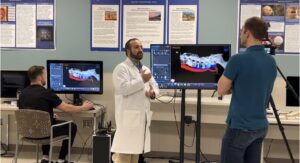
Surgical Theater was built as an adjunct to navigation, not a replacement for it. By pairing immersive 3D visualization with established navigation workflows, our eXperiential Reality platform enhances what surgeons already trust without forcing disruptive changes in the OR.
From Visualization to Clinical Impact
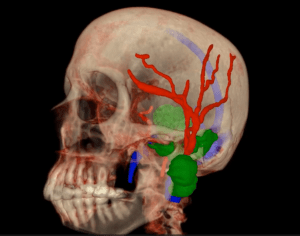
Our XR platform transforms traditional imaging into patient-specific 3D environments that surgeons can use to clarify complex anatomy before entering the OR, rehearse approaches and trajectories preoperatively, maintain spatial understanding during execution, and improve communication with patients and care teams.
For surgeons who say, “I do things by feel,” XR doesn’t replace experience. It reinforces it, providing another layer of clarity when cases are complex, anatomy is distorted, or margins for error are small.
And for patients, those same models create understanding and trust, turning abstract imaging into something tangible and informative.
Supporting Real Clinical Decisions, Every Day
At its core, surgical XR must support one thing above all else: better decision-making. That means tools that are consistent from clinic to OR, integrated rather than isolated, and proven across thousands of real cases.
This is what surgeons have told us they value. And it’s what guided Surgical Theater’s platform from the beginning. Because in surgery, reliability isn’t a feature; it’s the standard.
Built for Today and Prepared for What’s Next
A platform built for the long haul doesn’t rely on flash. It grows through deliberate, clinically driven innovation. Surgical Theater continues to invest in advancements such as AI-assisted segmentation, extending the platform’s value across planning and execution, without breaking workflow continuity. Technology becomes future-proof not by chasing trends, but by strengthening the foundation surgeons already rely on.